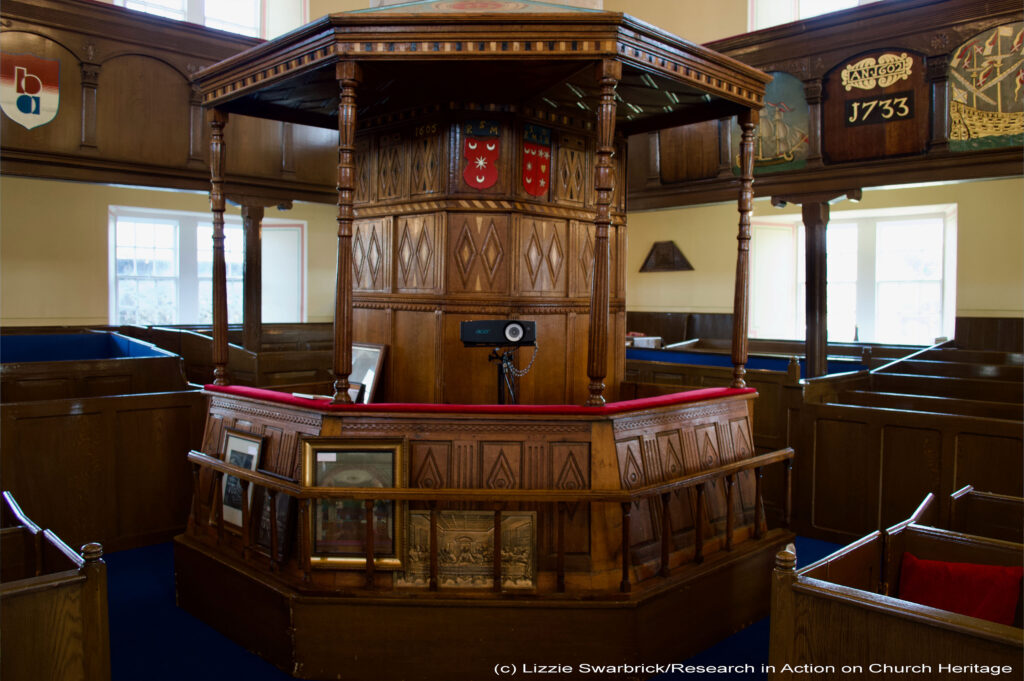
Box pews and pumfils: Originally most of the ground floor would have had few fixed seats; people would bring their own stools to sit on. The wooden benches or pews were installed in the 1700s and many carry the names of the estate or person who originally owned them. One is extra deep and is known as the Shepherd’s Pew because his sheep dogs had space there to lie at his feet. Two are double sided pews or pumfils. It is thought that the owners sat facing the minister and the servants sat at the other side of a narrow table with their backs to him.
Guilds: Apart from the sailors’ galleries, the pews in the galleries (and some on the ground floor) were reserved for the menfolk of the various trade guilds of the town. Their trade insignia decorate the gallery fronts. How many of these can you identify? The Guilds looked after their members and controlled their training and membership. You can think of them as the forerunners of today’s trade unions.
The north gallery was replaced in 1822 so the paintings on it are not so old as the others. However, two of the original north gallery panels hang on the east wall: One dated 1597 shows a man in 16th century clothes sitting at a loom weaving. The other dated 1609 belonged to the Prime Guilt Society (Shipmasters and Seamen) is made of different coloured wood inlays and shows a ship, possibly the Great Michael.